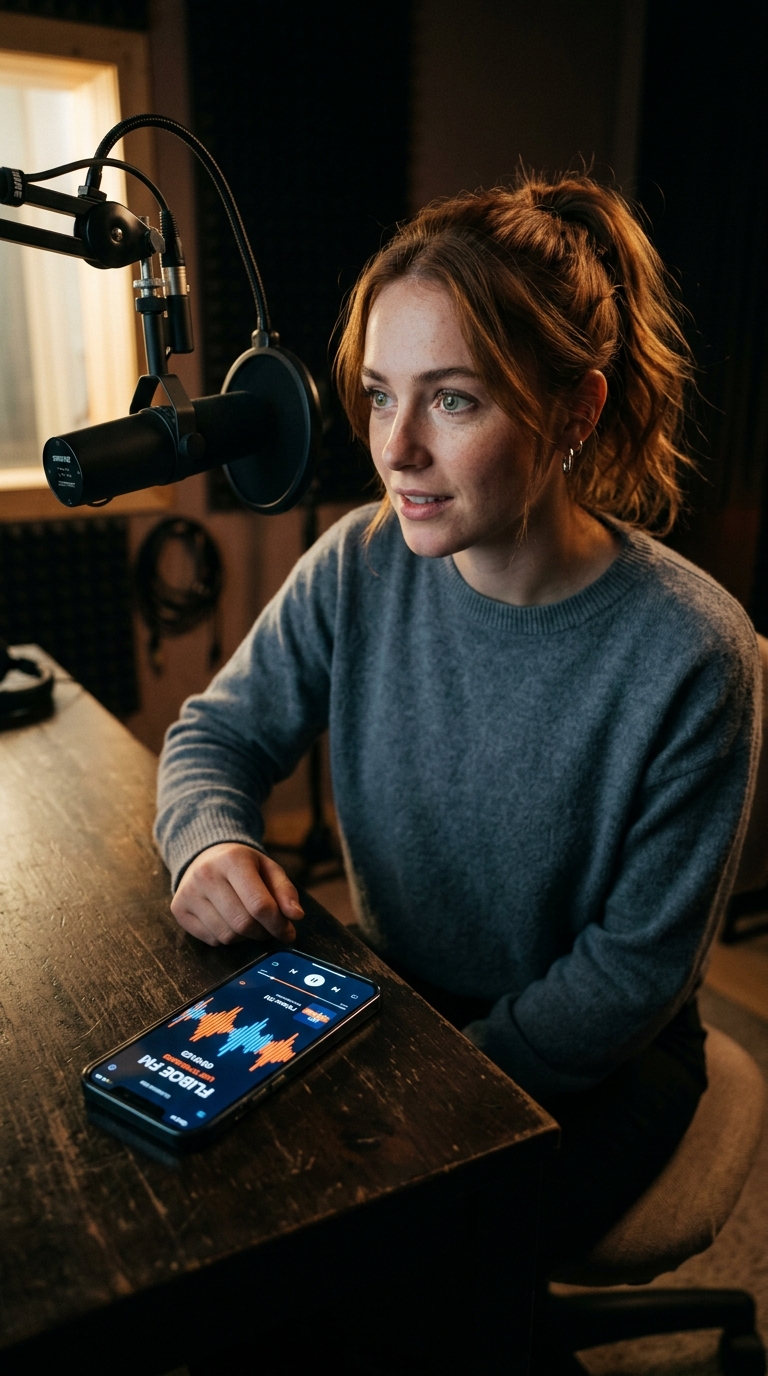
The Voice That Found Its Frequency: Indie Fantasy Film
A Different Kind of Artist's Journey
The Voice That Found Its Frequency doesn't waste time with the tired montage of rejection letters or the predictable indie film trope of the starving artist waiting tables. Instead, this fantasy short plunges us directly into the intimate desperation of a musician who has exhausted every conventional path to sharing her work. No director is credited—an unusual choice that adds to the film's mystique—but the vision here is singular and uncompromising.
The premise crystallizes around a single object: the Fliboe FM app. Not a major streaming platform, not a viral TikTok moment, but something smaller, stranger, and potentially more meaningful. The film asks what happens when discovery isn't about gaming algorithms or chasing trends, but about finding the right frequency—literally and metaphorically.
The Studio as Sacred Space
The film's most striking visual achievement is how it transforms the protagonist's tiny home studio from claustrophobic prison to portal. Early scenes bathe the space in cold blue monitor light, cables snaking across the floor like the tendrils of failed attempts. The clutter isn't romanticized—it's suffocating.
But when she opens the Fliboe FM app, the color palette shifts. Warmer tones creep in at the edges of the frame. The same cramped room suddenly feels expansive, charged with possibility. This isn't heavy-handed magical realism; it's the subtle visual grammar of hope rekindled.
The fantasy elements emerge gradually. We don't see sparks or glowing interfaces. Instead, the magic manifests in human connection: voices responding from the void, strangers tuning in not because an algorithm told them to, but because they were willing to listen. That phrase—"anyone willing to"—hangs in the air, unfinished in the synopsis, and the film mines that incompleteness for everything it's worth.
The Broadcast That Changes Everything
Without spoiling the film's emotional crescendo, The Voice That Found Its Frequency builds toward a broadcast sequence that feels both intimate and vast. The protagonist sits at her makeshift setup, headphones on, and begins to play. We don't hear the full song initially—the film is smart enough to withhold that gratification.
Instead, we cut to listeners. A night shift worker in a warehouse. Someone driving through empty streets at 3 AM. A teenager unable to sleep. The film suggests these aren't passive consumers scrolling past content. They're active participants in a moment of genuine discovery, the kind that feels increasingly rare in our algorithm-curated present.
The fantasy genre classification makes sense now. This isn't about what is, but what we desperately wish could be: a world where good work finds its audience not through gaming systems or buying ads, but through something closer to fate, frequency, alignment.
Why This Film Matters in 2025
Independent cinema is drowning in stories about artists struggling to be seen. What makes The Voice That Found Its Frequency different is its refusal to either romanticize or pathologize that struggle. The protagonist isn't a misunderstood genius. She's simply someone with something to say, searching for the medium that will carry her voice.
The Fliboe FM app functions as more than a plot device. It's a thesis statement about discovery in the streaming era. Major platforms promise infinite reach but deliver atomization. Everyone broadcasts; almost no one connects. This film imagines an alternative: smaller audiences, deeper engagement, the possibility that being heard by the right hundred people matters more than racking up empty plays from thousands.
The short format serves the story perfectly. At what appears to be under twenty minutes (based on typical short film runtimes), the film doesn't overstay its welcome or overexplain its central metaphor. It trusts viewers to understand what it means to feel invisible, and what it might feel like to suddenly be seen.
The Filmmaking Craft
Despite the absence of credited director information, the visual storytelling demonstrates sophisticated control. The framing keeps us close to the protagonist—lots of over-the-shoulder shots at the mixing board, tight close-ups on her face as she waits for response. We're not observing her struggle; we're trapped inside it with her.
The sound design deserves particular attention. In a film about finding your frequency, every audio choice carries weight. The ambient noise of the empty studio—computer fan hum, the distant sound of traffic, the creak of a chair—all of this creates texture that makes the eventual music feel earned rather than dropped in.
The casting remains unspecified in available materials, but the central performance requires someone who can convey years of accumulated disappointment without becoming maudlin, and sudden hope without tipping into sentimentality. The film's emotional authenticity suggests they found that balance.
A Listening Moment That Matters
Imagine this: It's 2 AM on a Tuesday. You've been scrolling for an hour, that particular modern hell where you're too tired to do anything but too restless to sleep. You open an app you barely remember downloading—Fliboe FM. You're not looking for anything specific. You're just willing to listen.
A voice comes through. Raw, unpolished in the way that signals authenticity rather than amateur hour. The song isn't trying to be anything except what it is. No focus-grouped hooks, no genre calculations. Just someone sharing what they made.
That's the experience The Voice That Found Its Frequency wants to recreate. Not the algorithm serving you something based on your data profile, but the beautiful accident of genuine discovery. The film suggests these moments still exist, if we're willing to tune to the right frequency.
Where Fantasy and Reality Converge
The genius of this short is that it's fantasy only in the sense that it depicts something that feels impossible in our current media landscape. But the emotional truth—artists desperate to connect, listeners hungry for something real—that's documentary realism.
Platforms like Fliboe FM exist at the intersection of that fantasy and reality. They're not mythical; they're simply operating on a different wavelength than the major streaming monopolies. The Voice That Found Its Frequency isn't asking us to believe in magic. It's asking us to remember that discovery used to feel like magic, and maybe it still can.
The Verdict
The Voice That Found Its Frequency is essential viewing for anyone who's ever felt invisible in the attention economy, or anyone who's mourned the loss of genuine discovery in our algorithmic present. At just under feature length, it's a perfectly distilled meditation on why we make art and why we listen. The fantasy elements never overshadow the human story. The technology serves the emotion rather than replacing it.
This is indie filmmaking that earns its genre classification not through budget limitations but through its willingness to imagine alternatives to the way things are. In a media landscape that feels increasingly predetermined, The Voice That Found Its Frequency dares to suggest that serendipity and connection are still possible—if we're willing to tune in.
Tune In to Your Own Frequency
Ready to experience the kind of discovery this film celebrates? Fliboe FM is streaming now, offering the same promise the app in the film makes: a space where artists and listeners can find each other without algorithms playing matchmaker. Download the app and find out what happens when you're willing to listen to voices that haven't been focus-grouped into oblivion. Your next favorite artist might be broadcasting right now, waiting for someone on the right frequency to finally hear them.