The Last Trade: When Algorithms Demand Everything
The Moment Before the Fall
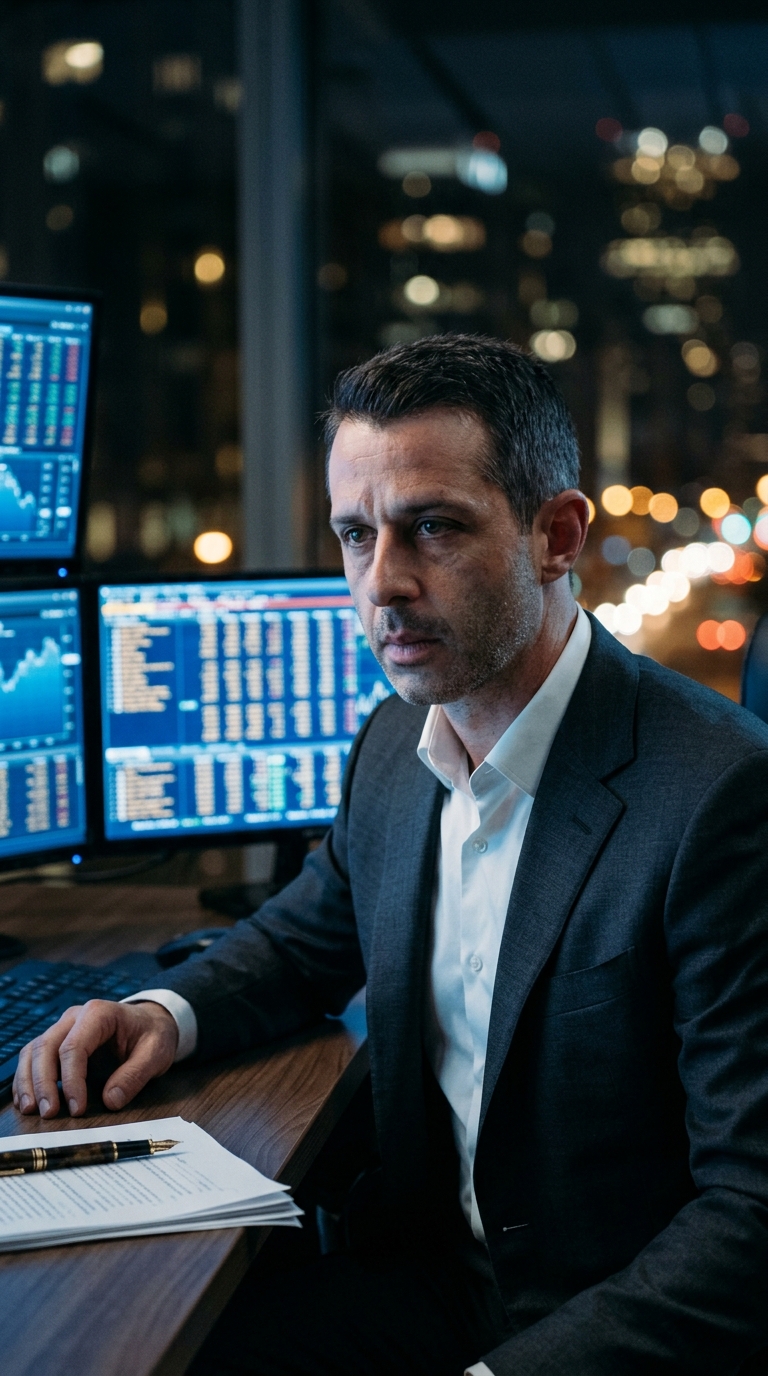
Marcus stares at his screen. Three years of sleepless nights, mental arithmetic, and gut-wrenching volatility have come down to this single click. The Last Trade doesn't need elaborate exposition or backstory montages—it trusts you to understand what obsession looks like. This indie drama short, available now for streaming, captures the precise instant when ambition curdles into desperation, when the numbers stop being abstract and start demanding flesh.
The film opens in medias res, which is exactly where it should. We don't need Marcus's origin story. We need to see him now, hollowed out and wired tight, watching decimal points flicker like morse code from a dying star. Director unknown, cast uncredited, but The Last Trade doesn't suffer from anonymity—it thrives in it. The facelessness becomes the point. Marcus could be anyone who's ever confused the map for the territory, the portfolio for the person.
Three Years Inside the Machine
The synopsis tells us Marcus "lived inside the numbers," and the film's visual language reinforces this with surgical precision. Every frame feels calibrated, measured, color-graded to the temperature of a server room at 3 a.m. The camera rarely moves. When it does, it's with the cold logic of a trading algorithm adjusting position size.
This isn't a thriller about market manipulation or Wall Street excess. The Last Trade operates at a more intimate register—the psychological thriller of self-destruction dressed in business casual. Marcus doesn't work for a hedge fund. He's alone. Just him, his setup, and the relentless hum of cooling fans. The algorithms he mentions aren't villains in pinstripe suits; they're the rules he's internalized so deeply they've replaced his circadian rhythm.
The brilliance here is restraint. We never see Marcus's life before. No girlfriend who left. No mentor who taught him everything. No moment of youthful promise squandered. The Last Trade understands that addiction—and make no mistake, this is an addiction film—doesn't need a backstory to be devastating. It just needs to show you the moment someone mistakes the edge for the exit.
The Final Confirmation: A Scene Study
The centerpiece of The Last Trade is the confirmation click itself. In lesser hands, this would be melodrama—swelling strings, a trembling finger hovering over the mouse, a flashback to what Marcus stands to lose. Instead, the film gives us silence. The cursor moves. Marcus clicks. The screen refreshes.
Then nothing.
Not immediately. The genius of this moment is the lag time, the seconds where the trade processes and Marcus sits in the space between his old life and whatever comes next. His face doesn't crumble. He doesn't smile with relief or grimace with regret. He just... empties. The weight the synopsis mentions isn't lifted—it's redistributed. From anticipation to consequence. From maybe to definitely.
This is where The Last Trade earns its place in the indie film conversation. It's not interested in explaining Marcus or redeeming him. It's interested in capturing the exact texture of a specific kind of modern ruin—the self-inflicted, algorithm-assisted, entirely voluntary kind.
Why This Matters Now
We're drowning in content about hustle culture, about optimization and passive income and five-hour morning routines. The Last Trade is the hangover after that party. It's the movie that asks: what happens when you actually do it? When you optimize yourself into a corner, when you trade everything liquid in your life for something you can chart on a graph?
The timing feels urgent. Crypto winter. Meme stock casualties. An entire generation taught that financial literacy means gambling on microcap stocks because rent is due and wages are stagnant. The Last Trade doesn't preach or lecture. It just shows you Marcus, and trusts you to recognize someone you know. Maybe someone you've been.
As indie film goes, this is essential viewing—not because it's flashy or innovative in technique, but because it's honest about something most films avoid. The market doesn't care about your story. The algorithms don't have character arcs. And sometimes, you don't get a third act redemption. Sometimes you just get the trade confirmation, and then you live with it.
The Visual Language of Isolation
Though the director remains uncredited, The Last Trade demonstrates a clear visual philosophy. The frame is always tight. Marcus occupies the center, but barely—there's negative space around him that suggests the void he's created in his own life. The color palette skews blue-green, that particular shade of LED lighting that feels like it's leaching warmth from the room.
There are no establishing shots of a city skyline. No cutaways to clocks or calendars marking time. Everything happens in this room, at this desk, in this chair. The claustrophobia is intentional. Marcus has compressed his entire existence into a trading terminal, and the film's aspect ratio feels like it's compressing him in return.
The only real movement comes from the screen itself—numbers updating, charts redrawing, the cursor traveling from one fate to another. In a film ostensibly about trading, about movement and volatility, everything human is static. Everything digital is alive. The reversal is complete.
Where to Watch and What It Costs
You can stream The Last Trade now, though like many indie drama shorts, it exists in that liminal space between festival circuit and wide release. The trailer available via /api/audio/showo_make_8763d9b21e9b.mp4 offers a glimpse, but the full experience demands your complete attention. This isn't background viewing. This is the kind of short that demands you sit in Marcus's chair with him, even when—especially when—you want to look away.
The runtime is brief, but The Last Trade doesn't feel rushed. It feels concentrated. Every second serves the inevitability of that click. Every frame builds the pressure until confirmation isn't a choice—it's the only possible next move.
For streaming platforms, this is exactly the kind of indie film that separates curated catalogs from algorithm-generated recommendation hell. The Last Trade won't play well to casual browsers. It's for the film fans who want to feel something specific and uncomfortable, who trust that not every story needs a happy ending or even an ending that makes traditional narrative sense.
The Sound of Nothing Changing
What The Last Trade understands about trading, about obsession, about the moment you realize you've spent three years building an elaborate cage, is that the revelation isn't loud. It's not a crash or a scream. It's the ambient hum of your equipment, the distant traffic outside your window, the sound of your own breathing now that there's nothing left to optimize.
The film ends where it begins: with Marcus and the screen. The numbers have changed. Marcus hasn't. Or maybe he has, and that's worse—maybe the change is that he's finally become exactly what the algorithms needed him to be. A vessel. A click. A confirmed trade in the endless sequence of trades that keep the machine running.
The Last Trade is a drama that understands cinema isn't about explaining—it's about showing. And what it shows is devastating in its simplicity: a man, a screen, a choice that was never really a choice at all. The indie film landscape needs more work this focused, this willing to sit with discomfort until discomfort becomes insight.
Tune In
If The Last Trade sounds like your kind of cinematic gut-punch, stream it now and experience what happens when indie drama strips away everything except the essential question: what do we trade ourselves for, and what's left when the transaction clears? This is the film you didn't know you needed, and once you've watched Marcus click that final confirmation, you won't be able to unsee what it reveals about the markets we make of our lives.