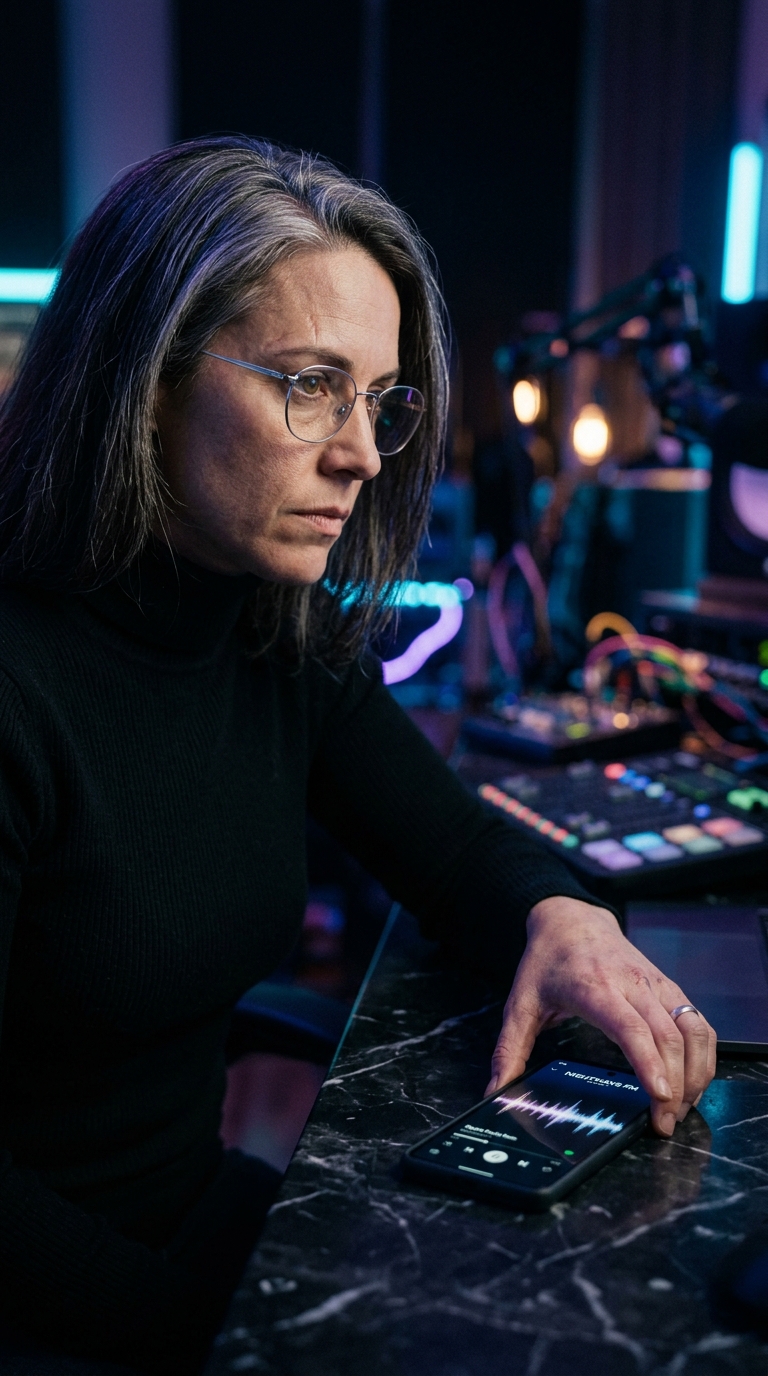
The Last Broadcast: When Indie Drama Meets Airwave Ghosts
A Frequency Lost, A Daughter's Obsession
She had been searching for three weeks, scrolling through hundreds of frequencies on the Fliboe FM app every night after midnight. The station her father used to broadcast from had vanished from the airwaves fifteen years ago, but she refused to believe it was gone forever.
This is the haunting premise of The Last Broadcast, an indie drama short that understands what most films forget: grief isn't always loud. Sometimes it's a woman hunched over a glowing screen at 2 AM, chasing static and phantom signals through the digital ether. The film transforms the simple act of radio-scanning into something closer to séance, where technology becomes the bridge between the living and the lost.
The Archaeology of Sound: What The Last Broadcast Excavates
The Last Broadcast operates in that liminal space between memory and obsession. The protagonist's nightly ritual—methodically cycling through frequencies on a streaming radio app—becomes a meditation on how we refuse to let go of the people who shaped us. Her father's pirate radio station disappeared when she was still a teenager, but fifteen years later, she's convinced the signal might resurface.
This isn't a film about radio nostalgia for its own sake. It's about the specific terror of losing someone's voice. Not their physical presence, but the actual timbre and cadence that made them real. The Fliboe FM app becomes her time machine, her Ouija board, her last desperate attempt to hear him one more time.
The drama unfolds with restraint. No flashbacks to father-daughter moments. No melodramatic voice-overs explaining her pain. Just the blue glow of a phone screen, scrolling numbers, and the crackling white noise between stations. The Last Broadcast trusts its audience to understand that sometimes the search itself is the story.
Visual Language: Darkness, Glow, and the Grammar of Loneliness
Though we don't have a credited director attached to The Last Broadcast, the visual approach is unmistakable: long takes, minimal lighting, and a color palette that lives entirely in the blue-black spectrum of 3 AM insomnia. The cinematography recalls the claustrophobic intimacy of Personal Shopper crossed with the technological dread of Pulse.
The frame rarely moves. Instead, we watch her face illuminated by the phone's glow, her thumb scrolling, her eyes searching. It's a bold choice in an era of hyperactive editing. The stillness forces us to sit with her compulsion, to feel the weight of each frequency that yields nothing but static.
When the camera does pull back, the compositions emphasize negative space—her small figure dwarfed by darkness, surrounded by the architecture of an empty apartment. The visual strategy is clear: this is a film about absence, about the holes people leave behind, and how we try to fill them with radio waves and desperate hope.
Why This Matters in 2025's Streaming Landscape
The Last Broadcast arrives at a peculiar cultural moment. We're drowning in content, yet starving for connection. Streaming services have given us unlimited access to every song, every show, every movie ever made—but they've also fragmented the shared experience of broadcast media.
The film's central tension—a daughter searching for her father's lost radio station—speaks directly to this paradox. The Fliboe FM app represents both abundance and loss: infinite stations, but the one she needs has vanished. It's a metaphor for how digital immortality promises everything while guaranteeing nothing.
For indie film audiences, The Last Broadcast offers something increasingly rare: a story that earns its emotions through specificity rather than manipulation. This isn't a film that explains grief. It shows you what grief looks like when it's been going on for fifteen years and nobody's watching.
The Midnight Listener: A Scene That Captures Everything
Imagine this: It's 1:47 AM on a Tuesday. She's been scrolling for ninety minutes, her thumb moving on autopilot through the numbered stations. 94.3—salsa. 94.5—classic rock. 94.7—static. 94.9—gospel. 95.1—
She pauses.
Not because she's found it. She pauses because her thumb is cramping. She sets the phone down, closes her eyes, and for exactly eight seconds, she considers giving up. Considers accepting that some signals die and stay dead. Considers sleeping.
Then she picks up the phone and keeps scrolling.
That's the scene. That's the whole film distilled into one moment. The Last Broadcast understands that dramatic tension doesn't require car chases or plot twists. Sometimes it's just the question of whether someone will keep searching or finally stop.
The Sound Design: What You Hear Between Stations
Audio is obviously central to The Last Broadcast, but not in the way you'd expect. The film's soundscape is built from negative space—the hiss between frequencies, the digital chirp of changing stations, the ambient hum of an apartment at night.
There's no score in the traditional sense. Instead, the music comes from the stations themselves, brief snatches of songs cutting in and out as she scrolls. We hear fragments: a guitar solo dissolving into static, a talk show host's voice emerging and vanishing, commercials for businesses that might not exist anymore.
This approach transforms the act of listening into something archaeological. Each frequency is a layer of sediment, a stratum of time, and she's digging through all of it looking for one specific fossil: her father's voice introducing a song, making a joke, saying her name.
Where to Watch The Last Broadcast and Why It Deserves Your Attention
You can stream The Last Broadcast directly through the platform's video player, making it immediately accessible for anyone curious about indie drama that takes risks. The short format—likely under 20 minutes—makes it perfect for viewers who want cinema that respects their time while delivering genuine emotional impact.
This is essential viewing for anyone exhausted by indie films that mistake quirk for depth or style for substance. The Last Broadcast is neither whimsical nor precious. It's a disciplined, focused piece of storytelling that knows exactly what it's about and refuses to apologize for its specificity.
For fans of character-driven drama, this film proves you don't need elaborate plots or large casts to create something memorable. You need a clear emotional throughline, a strong central metaphor, and the courage to let silence do the heavy lifting.
The Emotional Frequency: Why We Keep Searching
At its core, The Last Broadcast asks a simple question: When do we stop looking for the people we've lost? The film refuses to answer, which is precisely why it lingers.
The protagonist's nightly ritual might seem pathological, but the film treats it with respect. Maybe she's chasing ghosts. Maybe the station really is out there, broadcasting on some obscure frequency that she hasn't found yet. Maybe it doesn't matter. Maybe the search itself is how she keeps him alive.
The Last Broadcast understands that grief doesn't follow a timeline or a five-stage model. Sometimes it's scrolling through radio stations at 2 AM for three weeks straight. Sometimes it's believing in impossible things because the alternative—acceptance—feels like betrayal.
The film never judges her. It simply watches, listens, and waits alongside her. That empathy, that willingness to sit with discomfort without rushing toward resolution, is what elevates The Last Broadcast above typical indie drama fare.
Final Transmission: Why This Short Matters
The Last Broadcast is proof that you don't need budget or spectacle to create something that haunts viewers long after the credits roll. You need clarity of vision, emotional honesty, and the understanding that sometimes the most dramatic moments are the quietest ones.
This is a film about radio, but it's really about voice—how we remember it, how we search for it, how we refuse to accept its silence. In an age where everything is archived and nothing truly disappears, The Last Broadcast reminds us that some losses can't be undone with the right search term or the perfect algorithm.
For streaming audiences tired of algorithmic recommendations and looking for something genuinely different, this short delivers. It's uncomfortable, specific, and unapologetically small in scope. Which makes it, paradoxically, one of the bigger emotional experiences you'll find in indie drama this year.
Tune In: Experience The Last Broadcast Now
Ready to experience the haunting intimacy of The Last Broadcast? Stream it now and discover why sometimes the most powerful stories are the ones told in whispers and static. Whether you're a dedicated indie film enthusiast or simply curious about drama that takes creative risks, this short deserves your attention—and your late-night contemplation.