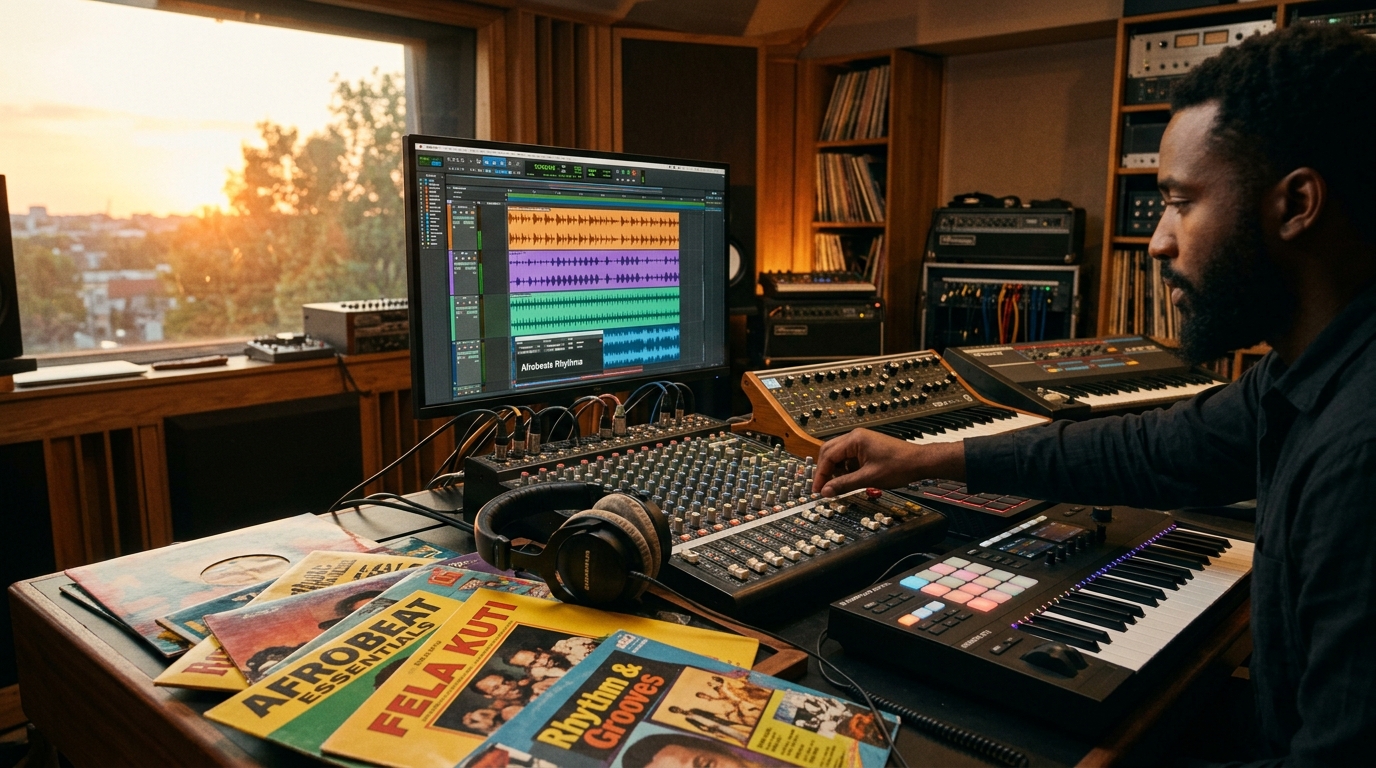
Anupkumar Raval on Afrobeats: The Mixed Sound Revolution
The Genre-Bending Architect Redefining Mixed Internet Radio
Picture this: It's 3 AM in Lagos, noon in London, and just after dinner in Los Angeles. A graphic designer in Berlin hits play on Afrobeats radio, expecting the traditional percussion-heavy grooves the station name promises. Instead, "The Badman Out" by Anupkumar Raval floods her headphones—a track that refuses to stay in its lane, weaving Afrobeats rhythmic DNA with unexpected electronic flourishes and production techniques that feel equally at home in Mumbai's underground club scene and Atlanta's trap studios. She's confused for exactly eight seconds before her head starts nodding. This is what mixed internet radio sounds like in 2025.
Afrobeats station isn't lying about its name, but it's not telling you the whole truth either. This is a mixed radio station in the truest, most rebellious sense—a platform where genre boundaries exist only to be crossed, where the "Afrobeats" label serves as a launching pad rather than a limitation. And at the center of their current rotation sits Anupkumar Raval, an artist whose entire discography reads like a manifesto against musical segregation.
Why Anupkumar Raval Dominates Afrobeats' Playlist
Raval currently occupies four slots in the station's recent rotation—"The Badman Out," "Stunna," "Magic City," and "Mr. Kool Kat"—a dominance that tells you everything about where mixed internet radio is heading. These aren't token inclusions or algorithmic accidents. They're deliberate programming choices that reflect a broader shift in how global audiences consume music.
"The Badman Out": Where Rhythms Collide
"The Badman Out" operates in the liminal space between cultures. The track's foundation borrows the syncopated hi-hat patterns characteristic of Afrobeats, but Raval layers them with bass frequencies that wouldn't sound out of place on a grime record. His vocal delivery switches between melodic hooks and rhythmic speech patterns that blur the line between singing and toasting. This isn't fusion for fusion's sake—it's the natural musical language of someone who grew up with YouTube recommendations that don't respect geography.
For listeners searching for how to listen to mixed radio online, this track exemplifies exactly why they're moving away from single-genre stations. The production quality rivals anything you'd find on major streaming playlists, but the creative freedom feels unshackled from commercial radio's need to fit into pre-existing format boxes.
"Stunna" and the New Global Sound
If "The Badman Out" introduces Raval's approach, "Stunna" confirms he's not a one-trick producer. This cut leans harder into electronic production, with synth choices that evoke both West African highlife melodies and the kind of sparkle you'd associate with contemporary Bollywood. The percussion remains distinctly polyrhythmic, but the arrangement makes space in ways traditional Afrobeats rarely does—moments of strategic silence that create tension before drops that hit with physical force.
What makes this essential programming for a station billing itself under the Afrobeats umbrella is how Raval honors the genre's core while expanding its vocabulary. He's not diluting the sound; he's arguing that Afrobeats was always meant to be a conversation, not a monologue.
The Mixed Internet Radio Renaissance
Afrobeats station represents a growing category of best mixed radio stations that understand contemporary listening habits better than legacy broadcasters ever could. Today's audience doesn't wake up thinking "I want to listen exclusively to one genre for the next four hours." They want sonic coherence without creative monotony.
What "Mixed" Actually Means in 2025
The term "mixed" used to imply randomness—a little pop, some rock, maybe jazz for credibility. On platforms like Afrobeats radio, "mixed" signals intentional curation across diaspora sounds. It means:
- Cross-pollinated production: Tracks that incorporate techniques and instruments from multiple traditions without reducing them to exotic flavoring
- Global artist rosters: Programmers who recognize that an artist from Gujarat might be making the most interesting Afrobeats-adjacent music today
- Rhythmic continuity: Mixing genres while maintaining the groove so transitions feel seamless rather than jarring
- Cultural respect: Blending without appropriating, honoring source materials while pushing them forward
This approach explains why "Magic City" and "Mr. Kool Kat"—Raval's other current tracks in rotation—don't feel out of place despite their sonic diversity. "Magic City" incorporates trap's rhythmic sensibilities with melody lines that could score a Nollywood romance. "Mr. Kool Kat" brings funk bass lines into conversation with talking drum patterns, creating something that doesn't exist in any genre handbook but makes perfect sense to ears trained on shuffle play.
Finding Your Gateway to Free Mixed Radio GLOBAL
The beauty of Afrobeats as a free mixed radio GLOBAL option is its accessibility paired with its specificity. You're not getting algorithm-generated playlists designed to be inoffensive background noise. You're getting human curation from programmers who clearly have opinions about where music should go next.
The Listening Experience
Tuning into this Afrobeats radio station means surrendering to a flow state where transitions matter as much as individual tracks. Between Raval's cuts, you might encounter:
- Established Afrobeats stars whose music benefits from being contextualized alongside genre-bending experiments
- Underground producers from unexpected geographic locations who understand the assignment
- Tracks that sample and reimagine classic Afrobeat (with the 't') in contemporary frameworks
- Remixes that treat the original genre as a foundation for global collaboration
This creates an educational experience disguised as entertainment. Listeners absorb musical connections they might never encounter on algorithm-driven platforms designed to keep you in your comfort zone.
Why Geography Doesn't Matter (But Still Does)
Afrobeats station broadcasts to a GLOBAL audience, which means someone in Tokyo experiences the same programming as someone in Toronto. Yet the music itself is deeply rooted in specific cultural contexts—West African rhythmic traditions, South Asian melodic approaches, Caribbean soundsystem culture, American hip-hop production ethics.
Anupkumar Raval embodies this paradox perfectly. His music wouldn't exist without globalization and internet-enabled cultural exchange, yet it's not placeless cosmopolitan mush. Each track carries distinct fingerprints from specific musical lineages. "Stunna" might play in twenty countries simultaneously, but it rewards listeners who catch the references, the subtle nods to genres and artists that influenced its creation.
This is the promise of mixed internet radio done right: music that's globally accessible but locally informed, crowd-pleasing without pandering, experimental without being exclusionary.
The Technical Advantage of Internet Radio for Mixed Programming
Traditional FM radio in most markets still operates on rigid format clocks. You can't play Anupkumar Raval's "The Badman Out" on a classic Afrobeats show because it's "too electronic," and you can't play it on an electronic show because it's "too worldbeat." These restrictions exist for advertiser comfort, not listener satisfaction.
Internet radio platforms demolish these artificial barriers. Afrobeats station can program based on feel, energy, and cultural resonance rather than Billboard chart categories. The result is a listening experience that reflects how people actually engage with music in 2025—promiscuously, curiously, with more interest in what sounds good than what genre tag applies.
How to Listen to Mixed Radio Online: The Practical Side
Accessing stations like Afrobeats requires nothing more complicated than an internet connection and a device. No subscriptions, no geographic restrictions, no need to own specialized equipment. This democratization means:
- Discovery becomes effortless: You don't need to know Anupkumar Raval's name to hear his music; the station's curation does that work
- Global premieres happen everywhere: A track can debut simultaneously to audiences across continents
- Niche can scale: Music too specific for commercial radio finds audiences large enough to sustain artists
The station operates as both a discovery engine and a validation mechanism. When you hear Raval's "Mr. Kool Kat" four times in an afternoon rotation, you're not experiencing payola—you're hearing programmers make a statement about where the culture's heading.
The Artist-Station Symbiosis
For producers like Anupkumar Raval, platforms like Afrobeats radio solve the categorization problem that plagues streaming services. Where does an artist who blends Afrobeats, electronic, and South Asian influences belong in Spotify's taxonomy? The answer is "nowhere comfortably," which means algorithmic discovery favors more easily categorized artists.
Mixed internet radio stations curate context. They tell listeners: "If you're here for Afrobeats energy but want your ears challenged, this is your destination." That value proposition attracts exactly the audience most likely to appreciate Raval's boundary-dissolving approach.
The four-track rotation isn't artist favoritism—it's programming strategy. It signals to regular listeners that this station takes risks on artists who might not have major label muscle but possess the creative vision to define what comes next.
The Future Sounds Like This
The dominance of artists like Anupkumar Raval on mixed radio stations points toward music's inevitable future. As global collaboration becomes standard rather than exotic, as production tools democratize, as audiences grow comfortable with genre fluidity, the question isn't whether mixed programming will overtake format radio—it's how long legacy systems will resist.
Afrobeats station doesn't need to convince anyone that this approach works. The listener numbers speak. The engagement metrics from fans in dozens of countries confirm what anyone with functioning ears already knows: restrictions are boring, and music sounds better when it's allowed to breathe across boundaries.
Raval's tracks offer a masterclass in this philosophy. They're specific enough to have identity, broad enough to connect across cultures, innovative enough to justify repeated listening, and groovy enough that none of the intellectual framework matters when you're just trying to make it through your commute with your sanity intact.
Tune In and Join the Conversation
Afrobeats radio runs 24/7, which means right now—this exact moment—someone somewhere is discovering Anupkumar Raval for the first time, having their expectations of what "Afrobeats" can mean permanently expanded. The best mixed internet radio doesn't wait for permission or validation from traditional gatekeepers. It just plays the music that deserves to be heard and trusts listeners to recognize quality when they encounter it. Hit play and find out what the future sounds like.