Anup Raval's Forsaken B&B: Indie Film Horror Done Right
When a Weekend Escape Becomes Your Worst Nightmare
There's a particular breed of indie film that understands dread better than any studio tentpole ever could. Forsaken B&B - You may leave but it follows, the sci-fi horror short from director Anup Raval, exists in that rare space where atmosphere does the heavy lifting and silence becomes weaponized. This isn't jump-scare fodder designed for algorithmic virality. This is patient, creeping horror that follows you home after the credits roll.
Raval, who also stars in this tight 15-minute nightmare, builds his tension from the most universal anxiety: the sinking realization that the place you thought was sanctuary might actually be a trap. A city-worn tourist checks into a countryside bed and breakfast, seeking nothing more than rest. What he finds instead is a masterclass in slowly escalating wrongness—overly attentive hosts, architectural impossibilities, and the gnawing sense that leaving might not be an option anymore.
The Indie Film Advantage: Constraints Breed Creativity
Watch the trailer and you'll immediately notice what Forsaken B&B accomplishes with minimal resources. Where big-budget horror drowns tension in CGI spectacle, Raval leans into practical filmmaking: shadow play, spatial confusion, and performance nuance. This is the indie film ethos at its sharpest—limitations become language.
The sci-fi horror hybrid genre here isn't accidental window dressing. Raval uses science fiction elements to subvert the familiar "creepy inn" trope. This isn't supernatural evil; it's something architecturally wrong with reality itself. The bed and breakfast becomes a puzzle box, a Möbius strip of hallways and rooms that shouldn't connect the way they do. It's Primer meets The Shining, filtered through the claustrophobic lens of short-form storytelling.
What Makes This Short Film Essential Viewing
Forsaken B&B matters because it demonstrates three things indie filmmakers constantly struggle to balance:
- Economy of storytelling: Every frame advances either plot or atmosphere, never both lazily
- Genre fusion that serves theme: The sci-fi elements aren't gimmicks; they're metaphors for entrapment and cyclical exhaustion
- Actor-director synergy: Raval's dual role creates fascinating vulnerability—you watch him direct himself into corners he must then perform his way through
Anup Raval's Vision: Architectural Horror and the Inescapable
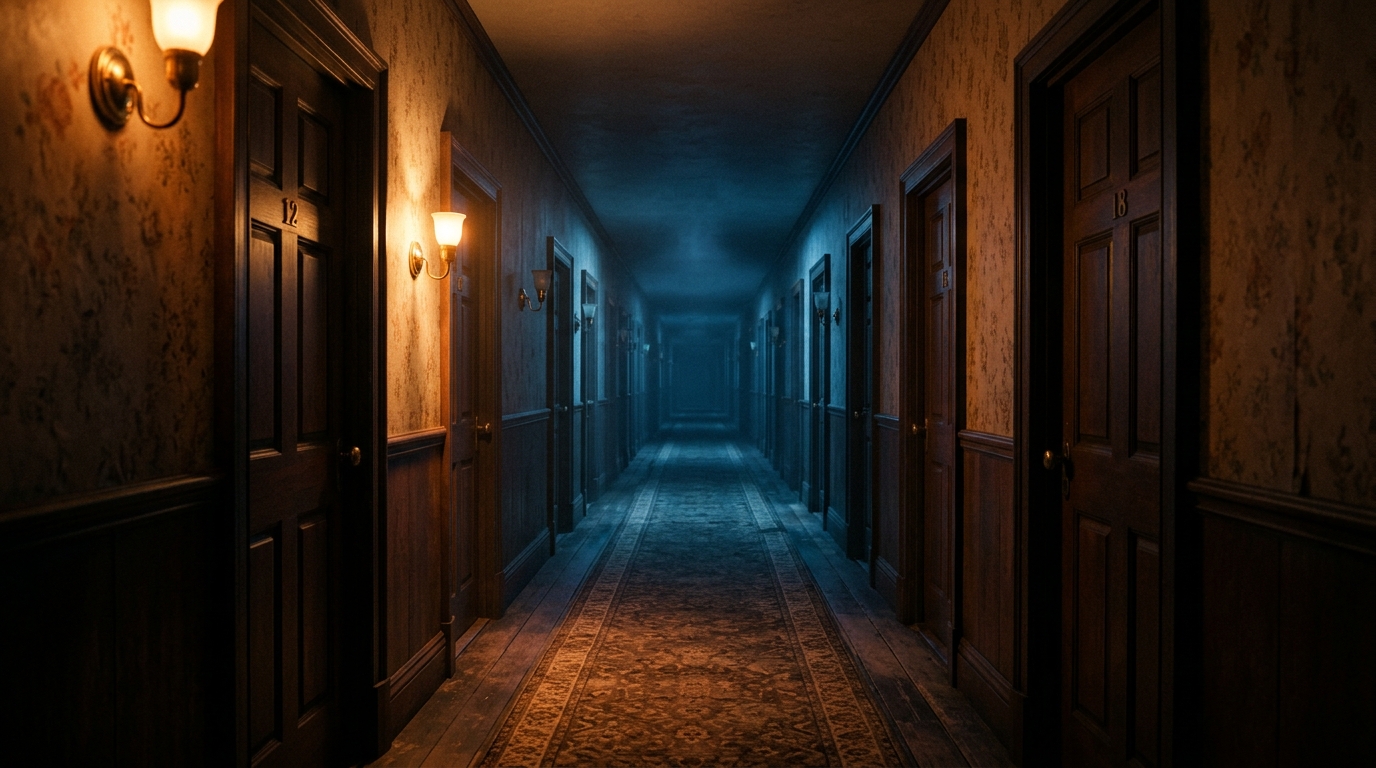
Raval's directorial approach reveals influences from slow-burn European horror and cerebral sci-fi. There's a Kubrickian attention to symmetry in his framing—hallways filmed with centered, unwavering perspectives that make spatial continuity deliberately suspect. But unlike Kubrick's cold formalism, Forsaken B&B pulses with handheld intimacy during its character moments.
The bed and breakfast itself becomes the film's second character. Raval films it as both charming pastoral refuge and geometric impossibility. Wide shots establish cozy familiarity; close-ups reveal details that shouldn't exist. A door appears where no door was moments earlier. A staircase descends when it should ascend. These aren't errors—they're the entire horrifying point.
What separates this from generic "weird location" horror is intentionality. Raval isn't interested in explaining the B&B's impossible architecture. He's interested in what that impossibility does to someone who just wanted to rest. The sci-fi horror framework allows him to explore exhaustion itself as an inescapable loop. You can check out anytime you like, but even when you leave, it follows.
Performance Under Pressure: Raval as Actor and Subject
Directing yourself is notoriously difficult—ask any filmmaker who's tried. You're simultaneously inside the performance and outside evaluating it, creating a schizophrenic creative process that often results in either self-indulgent excess or timid restraint. Anup Raval threads this needle with surprising control.
His performance as the unnamed tourist carries the short's entire emotional arc. Watch how his body language shifts across the runtime: initially loose and relieved (finally, countryside peace), gradually tightening (something's off here), eventually fraying into frantic spatial confusion (where am I, actually?). There's no dialogue-heavy exposition dump. Raval conveys the dawning horror through physicality—the way he checks the same doorway twice, the hesitation before trusting a staircase, the defeated slump when he realizes escape might be theoretical.
This indie film choice—minimal cast, maximum interiority—forces viewers into the protagonist's increasingly unreliable perspective. We don't get cutaways to explain what the hosts are planning or what the B&B really is. We're as trapped and confused as he is.
Where Sci-Fi Horror Meets Indie Authenticity
The beauty of Forsaken B&B - You may leave but it follows lies in its genre honesty. Too many indie films dress up derivative concepts in "elevated horror" aesthetics, hoping slow pacing equals profundity. Raval does something harder: he commits fully to being a sci-fi horror short while maintaining thematic depth.
The "it follows" concept in the title isn't metaphorical handwaving—it's the film's literal nightmare logic. Even if you physically leave the bed and breakfast, the experience of being trapped has restructured your reality. The sci-fi element suggests this might be temporal, dimensional, or psychological entrapment. The horror element doesn't care which—it just knows you can't actually escape.
This is why the short format works perfectly here. Feature-length would demand answers, mythology, backstory. Fifteen minutes allows Raval to pose the question and walk away, leaving viewers with the most unsettling possibility: that the tourist's exhaustion-driven need for escape created a trap worse than the city he fled.
Streaming Availability and Why This Matters Now
Finding where to watch Forsaken B&B requires some digital digging—the hallmark of truly independent cinema. The YouTube trailer serves as both teaser and calling card for festival submissions and streaming platform interest. This is how indie film actually works in 2025: micro-budget shorts build audience and industry attention before securing wider distribution.
Why does this particular short matter right now? Because it represents a counter-movement to algorithm-optimized content. Anup Raval isn't making TikTok-ready horror skits or three-act Netflix formula. He's crafting deliberate, patient genre cinema that trusts audiences to sit with discomfort. In an era of instant gratification, Forsaken B&B demands you marinate in its wrongness.
For film fans discovering new indie work, this short offers a masterclass in doing more with less:
- Location as antagonist: The B&B isn't a setting; it's the threat
- Genre hybridity with purpose: Sci-fi concepts serve horror execution
- Minimalist cast maximizing tension: Fewer characters mean deeper unease
- Ambiguity as strength: Not explaining everything is the entire point
The Scene That Defines the Film
There's a moment midway through Forsaken B&B that crystallizes Raval's vision. The tourist, now suspicious, decides to test the building's geography. He walks down a hallway, noting specific details—a painting, a light fixture, a window overlooking farmland. He turns a corner, walks what should be a perpendicular path, and arrives back at the same hallway. Same painting. Same fixture. Same window view.
But something's different. The light has changed imperceptibly. The painting hangs three inches lower. The window view shows farmland at a different time of day.
Raval holds on his character's face as this registers. There's no dramatic music sting, no sudden camera movement. Just the slow, awful realization sinking in: space itself is compromised. This is sci-fi horror operating at peak efficiency—one simple, impossible geography lesson that unmakes reality.
Why Indie Film Needs More Anup Ravals
The indie film landscape drowns in two extremes: ultra-low-budget found-footage experiments with no craft, or Sundance-polished "indies" with studio-level budgets. Forsaken B&B - You may leave but it follows occupies the vital middle ground—visibly micro-budget but cinematically literate, rough around the edges but thematically sharp.
Anup Raval demonstrates what happens when a filmmaker understands genre history without being enslaved by it. You can feel The Twilight Zone in the premise, House of Leaves in the spatial wrongness, Triangle in the temporal confusion. But the execution is distinctly his: patient, grounded, committed to making the familiar uncanny.
This is the kind of indie film work that deserves festival attention and streaming platform acquisition. Not because it's perfect—the budget constraints occasionally show—but because it's trying something. It has a vision and executes that vision with the resources available. That's increasingly rare in an indie landscape that often mistakes slowness for substance or quirk for personality.
The Future Beyond the B&B
If Forsaken B&B is any indication, Anup Raval possesses the genre instincts and directorial control to make compelling feature-length work. The question is whether he'll expand this specific concept (what would 90 minutes of impossible-geography horror look like?) or use this short as proof-of-concept for new nightmares.
Either way, the short accomplishes its mission: establishing a filmmaker with a specific voice in sci-fi horror, capable of wringing maximum tension from minimal resources. For audiences hungry for indie film that actually takes risks within genre frameworks, Forsaken B&B - You may leave but it follows delivers.
Tune In to the Terror
Ready to experience the creeping dread of Forsaken B&B - You may leave but it follows? Check out the trailer on YouTube and follow Anup Raval's work as it finds distribution. This is indie film horror that proves sometimes the smallest stories leave the deepest scars—and sometimes, even when you leave, it follows.