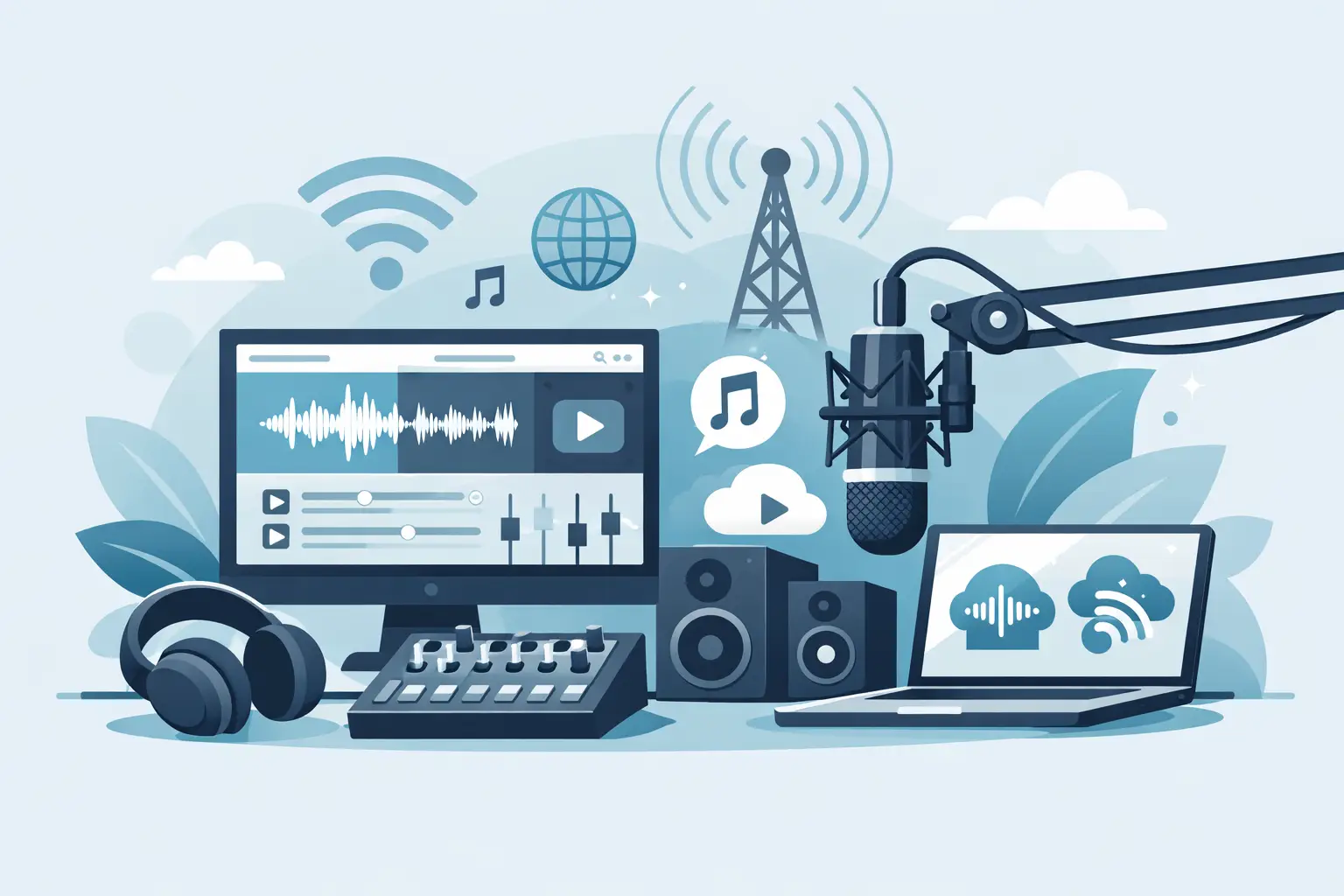
A good internet station does not start with gear. It starts with a feeling. Maybe you want listeners to catch late-night edits, niche genre picks, scene updates, or a voice they come back to every day. This internet radio station setup guide is built for creators who want that experience live fast, without turning the launch into a technical side quest.
The biggest mistake is thinking internet radio works like old-school broadcast. It does not. You are not building a tower. You are building a format, a rhythm, and a reason to tune in. The tech matters, but only after you know what kind of station people should remember.
Start with the station concept, not the software
Before you touch settings, name the lane. Is this a 24/7 music station for a niche audience? A community stream for your fan base? A branded audio channel for your media project? Those are all internet radio stations, but they need different programming choices.
A focused station wins faster than a broad one. "Good music" is not a format. "Underground dance cuts with short scene updates" is. "Alt R&B and voice drops from the host" is. "Anime remix radio for a Discord community" is. Specific beats generic every time because listeners need to know why your station exists.
This is also where tone gets set. If your station feels playful, intimate, high-energy, or editorial, that should show up in the music flow, host breaks, imaging, and schedule. Radio is brand-building through repetition. Every hour teaches people what you are.
The core of an internet radio station setup guide
The practical setup is simpler than most people expect. You need four things: a format, audio content, a streaming workflow, and a way for listeners to tune in consistently. If one of those is weak, the station feels unfinished.
Your audio content is the center of everything. That can include music, pre-recorded voice segments, station IDs, interviews, ambient blocks, countdowns, or sponsor reads. The right mix depends on how hands-on you want to be. Some creators want to host daily. Others want an always-on station that runs even when they are offline.
That is where automation becomes useful. If you are trying to manually run every transition, your station will probably go dark the second life gets busy. Automation gives the station continuity. It keeps the experience alive while you work on growth, programming, and promotion.
The listener side matters just as much. People should be able to press play and instantly understand the vibe. If access feels confusing or unreliable, they bounce. Internet radio is still radio - low friction wins.
Choose your setup based on how you want to operate
There is no single perfect build. The right setup depends on whether you want live hosting, automated programming, or a mix of both.
If you want a station that runs around the clock with minimal effort, start with scheduled playlists, station IDs, and short voice breaks. This is the fastest route to launch. It also creates consistency, which matters more than constant novelty when you are building habit.
If you want more personality, add hosted segments. That can mean intros between songs, daily recaps, artist callouts, themed blocks, or commentary. The trade-off is time. A personality-led station can feel more memorable, but it asks more from you operationally.
A hybrid model is usually the sweet spot. Let automation carry the base schedule, then drop in live or pre-recorded moments that make the station feel human. That gives you presence without forcing you to become a full-time board operator.
Build programming that sounds intentional
A station is not just a playlist on repeat. Programming is what makes it feel alive.
Start by organizing your content into blocks. Maybe mornings lean upbeat, afternoons go deeper, and nights get more experimental. Maybe Fridays have guest picks and Sundays slow down. These patterns help listeners build a relationship with your station. They start knowing when to tune in.
Transitions matter more than most new creators think. Hard cuts between random songs make a station feel cheap. Even simple voice breaks, IDs, or short branded moments can make the experience feel designed. This is one reason AI DJ tools are useful when used well. They can add continuity and pacing without forcing you to record every segment yourself.
Keep those breaks short. Radio energy comes from momentum. If every interruption drags, the station feels cluttered. The goal is not to talk over the music. The goal is to create identity between tracks.
Sound quality matters, but not in the way people think
You do not need a studio full of equipment to sound credible. You do need clean source audio, balanced levels, and a stream that feels stable.
A lot of new stations overinvest in mics and underinvest in consistency. Listeners will forgive a modest setup faster than they will forgive uneven volume, awkward silence, or a stream that cuts out. Start simple. Use clean files. Normalize your voice segments so they are not dramatically louder or quieter than the music. Test transitions before you go live.
If you are adding hosted intros, record in a quiet room and keep delivery tight. Sounding clear beats sounding overly polished. Internet radio is intimate. People respond to confidence and taste more than fake broadcast voice.
Make the station feel live, even when it is automated
This is where many creator-led stations either click or disappear. A static stream can sound dead, even if the music is good. A few smart touches make it feel current.
Use timely voice breaks. Mention the day, a theme, a recent release, or what is coming up next. Rotate station IDs so the stream does not feel looped. Refresh artwork, naming, and programming blocks often enough that regular listeners notice movement.
If your platform supports synchronized listening across different locations, that is a real advantage. Shared timing changes the feel of the experience. It turns passive listening into a moment people can join together. That is closer to actual radio than a playlist ever gets.
Don’t ignore monetization during setup
A lot of creators treat monetization like a future problem. That usually means they build audience behavior without giving fans any clear way to support the station.
You do not need to force revenue on day one, but you should decide what support looks like. Tip jars are a clean option because they fit the medium. A listener hears something they love, feels connected to the station, and can respond right there. That is much more natural than trying to push people into a complicated funnel later.
This is especially useful for niche stations. You may not need massive scale if the audience is loyal and engaged. A smaller station with a strong identity can outperform a bigger, blurrier one when support is direct.
Your internet radio station setup guide should include launch strategy
The setup is not finished when the stream works. It is finished when people know why they should tune in.
Launch with a point of view. Tell people what the station is, who it is for, and what they will hear this week. Give them recurring reasons to return, not just a generic announcement that the station is live. A themed launch schedule works better than a vague debut.
Create early rituals. A daily opener. A Friday mix block. A listener shoutout hour. A signature style of voice break. These are small moves, but they turn a stream into a habit.
If you are using a platform like Fliboe FM, the appeal is speed. Free to launch matters because it lets you test the station idea before turning it into a complicated project. That is the right order. Prove the concept. Build the audience. Then expand what works.
What to avoid on day one
The fastest way to stall is trying to make your station do everything at once. Too many genres, too much talking, too many experiments, too much branding, too many technical layers. Radio gets stronger when it gets clearer.
Do not wait for a perfect setup. Perfect usually means delayed. Start with a station that sounds coherent for one week of programming. That is enough to learn from real listeners.
Also, do not copy traditional radio too literally. You are not trying to imitate a commercial FM station from 2007. Internet radio lets you be more specific, more global, and more culture-driven. Use that. Your edge is not old infrastructure. It is taste, speed, and community.
The best station to launch is the one you can actually keep running. Keep it focused. Keep it recognizable. Keep it easy to tune into. If people can feel the identity within a few minutes, you are already ahead of most new streams.